Updated September 2026 · 7 min read
Short answer: To buy phone accessories wholesale without getting junk, order samples first, test them like a customer would, and ask for proof of safety and compliance before you place a real order. For anything that plugs in or holds a battery, that proof matters more than the price.
If you’re wondering how to buy phone accessories wholesale for a shop, kiosk, or online store, you’re looking at one of the easiest categories to start with and one of the easiest to get burned in. Cases, cables, chargers, and screen protectors are small, cheap to ship, and sell all year. They’re also flooded with low-quality stock that looks fine in a photo and fails in a week.
This guide walks you through what to buy, where to find suppliers, what to test, and how to price it so returns don’t eat your profit.
Why are phone accessories a good wholesale category?
Phone accessories are a steady seller because almost everyone owns a phone, and people replace cases, cables, and chargers often. Cables fray, cases crack, and a new phone model means a new case size.
They also have a few practical advantages for small sellers:
- Small and light. You can store hundreds of units on a single shelf, and shipping costs stay low.
- Impulse-friendly. A $15 cable or $20 case is an easy add-on at a checkout counter.
- Healthy markups. Wholesale unit costs are often low, so a 2× to 3× markup is common for basic items (example range, not a guarantee).
The catch is quality. The same-looking cable can come from a careful factory or from someone cutting every corner. Your job is to tell them apart before you buy 500 of them.
What phone accessories sell best at wholesale?
Start with the items people need, not the novelty items people might want. Here’s a simple breakdown:
| Accessory | Why it sells | Main quality risk |
|---|---|---|
| Charging cables | Wear out and get lost | Thin wiring, weak connectors, slow charging |
| Wall chargers and car chargers | Needed with every new phone | Overheating, poor safety design |
| Cases | New phone = new case | Wrong fit, yellowing, weak corners |
| Screen protectors | Cheap insurance for an expensive screen | Bubbles, poor fit, cutouts in the wrong place |
| Power banks | Travel and commuting | Battery quality and fire risk |
| Mounts, stands, and grips | Car and desk use | Weak adhesive or magnets |
For a first order, many small shops start with cables, wall chargers, and cases for the most common current phone sizes. Add power banks only once you have a supplier who can back up battery safety claims.
How to buy phone accessories wholesale: step by step
Here’s the process that keeps you out of trouble.
At a glance: Buying phone accessories wholesale
1
Pick your lineup. Choose 10 to 20 core products for the phones your customers actually use.
2
Shortlist suppliers. Find 3 to 5 suppliers who list specs, compliance info, and clear terms.
3
Order samples. Buy a few units of each item and test them at home or in the shop.
4
Place a small first order. Start near the minimum and reorder what sells.
1. Pick your lineup
Look at what phones your customers carry. Case sizes are model-specific, so a case for an older model sits on your shelf forever. Cables and chargers are more flexible because they’re tied to connector types, not exact models.
2. Shortlist suppliers
You’ll find phone accessory suppliers through online B2B marketplaces, general merchandise wholesalers, electronics distributors, and trade shows in your region. Good suppliers list real specs (wattage, cable length, connector type) and can answer compliance questions without dodging. If you’re not sure who’s legit, read our guide on how to verify a wholesale supplier before you send money.
3. Order samples
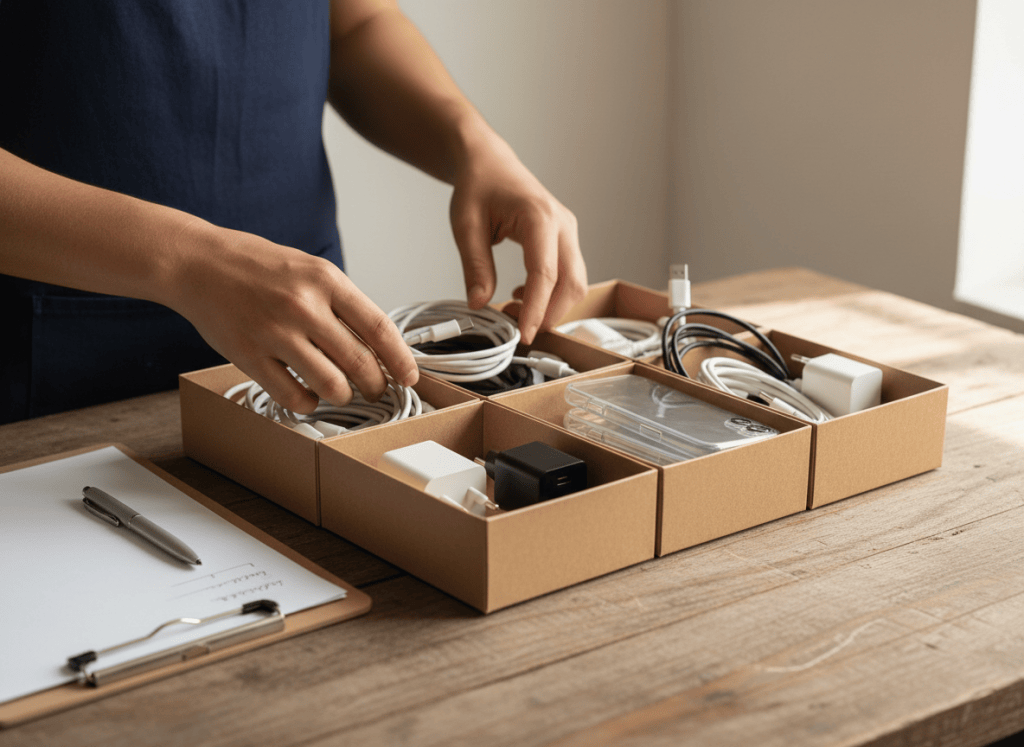
Never skip this step for electronics. Our guide on how to order product samples from a supplier covers how to ask for them and what they usually cost. Test each sample the way a customer would: plug it in, use it for a week, bend the cable, drop the case.
4. Place a small first order
Keep the first order close to the supplier’s minimum. If the minimum is too high for your budget, it’s often negotiable. See how to negotiate a minimum order quantity for scripts that work.
How do you tell good phone accessories from junk?
You don’t need a lab. A few simple checks catch most of the problems.
Checklist: Testing phone accessory samples
- ✅ Charger gets warm, not hot, after 30 minutes of charging
- ✅ Charging speed roughly matches the listed wattage
- ✅ Cable connector fits snugly and doesn’t wiggle loose
- ✅ Cable survives a few hundred bends near the connector without cutting out
- ✅ Case lines up with buttons, ports, and camera cutouts
- ✅ Screen protector goes on without bubbles and doesn’t block the front camera
- ✅ Packaging lists specs, a business name, and country of origin
- ✅ Weight feels right compared with a known-good product
That last one sounds odd, but it’s useful. Very light chargers can be a sign of skimped internal parts. Compare the sample to a charger you already trust.
Red flags in a phone accessory listing
- Wattage or battery capacity numbers that seem too good for the price
- No specs at all, just photos
- Brand-name logos on products from a supplier who isn’t an authorized seller
- The supplier can’t or won’t share any test reports
- Prices far below every other supplier for the same spec
Logos matter. Selling accessories that copy another company’s trademark can get your stock seized and your selling accounts suspended. Stick with unbranded products or your own label.
What safety and compliance rules apply?
Electronics come with more rules than cases and grips. Here’s what to know in plain terms. This is general information, not legal advice. Check with a compliance professional for your specific products.
FCC equipment authorization
In the U.S., electronic devices that give off radio-frequency energy fall under Federal Communications Commission (FCC) rules. That includes digital devices and external power supplies like wall chargers. Under the FCC’s Part 15 rules, these “unintentional radiators” must be authorized before they’re marketed, through either a Supplier’s Declaration of Conformity (SDoC) or FCC certification. Wireless products, like wireless chargers or Bluetooth items, have their own authorization requirements.
What this means for you: ask the supplier which authorization path the product uses and for the supporting test report or FCC ID where one applies. A supplier who has never heard the question is a warning sign.
Electrical safety testing
Wall chargers and power banks should be tested to recognized electrical safety standards by an accredited lab. Many retailers require this before they’ll stock a charger, and it protects you if something goes wrong. Ask for the test report and check that the product name and model number match what you’re buying.
Battery products and recalls
Power banks with lithium-ion batteries can overheat and catch fire if they’re poorly made. The Consumer Product Safety Commission (CPSC) has announced a number of power bank recalls in 2025 and 2026 because of fire and burn hazards. Before you stock any battery product, search the CPSC recall list for the product type and model. Batteries also come with shipping restrictions, so ask your supplier and carrier how they handle them.
How should you price wholesale phone accessories?
Price from your full cost, not just the unit price on the invoice. Add shipping, packaging, and a small allowance for returns and defects.
Landed cost per unit = (product cost + shipping + duties/fees + packaging) ÷ units
Example: 200 cables at $2.00 each = $400. Shipping $60, packaging $20. Total $480 ÷ 200 = $2.40 landed cost per cable.
At a 3× markup, retail = $2.40 × 3 = $7.20. Round to $7.99 for the shelf.
Build in a defect allowance. If 3% of chargers come back, that cost has to be covered by the other 97%. Cheap stock with a high return rate often earns less than better stock at a higher unit cost.
3×
Common example markup for basic cables and cases
5–10
Sample units per product to test before a bulk order (rule of thumb)
0
Brand logos you should accept from an unauthorized supplier
FAQ
Can I buy phone accessories wholesale without a business license?
Some suppliers will sell to anyone, but most wholesale suppliers ask for a business license, tax ID, or resale certificate. Having them also lets you buy without paying sales tax on inventory you’ll resell, depending on your state.
What’s a good first order size for wholesale phone accessories?
Many small shops start with 20 to 50 units per product across 10 to 20 products. That’s enough to learn what sells without tying up too much cash.
Are cheap wholesale phone chargers safe?
Some are, many aren’t. Price alone won’t tell you. Ask for safety test reports and FCC authorization details, then test samples yourself before you buy in bulk.
Can I sell phone accessories under my own brand?
Yes. Many suppliers offer private label or custom packaging, often with a higher minimum order. You then become responsible for the product’s compliance, so get the paperwork in your name where needed.
Bottom line
Phone accessories are a smart, low-cost category, but only if you test before you buy. Start with cables, chargers, and cases, ask every supplier for specs and compliance paperwork, and order samples every time. A slightly higher unit cost is worth it if it means fewer returns and no safety surprises.



 Wholesale Handbook
Leave a comment