Updated September 2026 · 9 min read
Short answer: To buy jewelry wholesale, get your resale certificate, pick a price point and material type that fits your customers, and buy from vendors who clearly disclose metals, plating, and stones. Order samples first, price at two to three times wholesale for fashion pieces, and make sure anything marketed to kids meets federal lead limits.
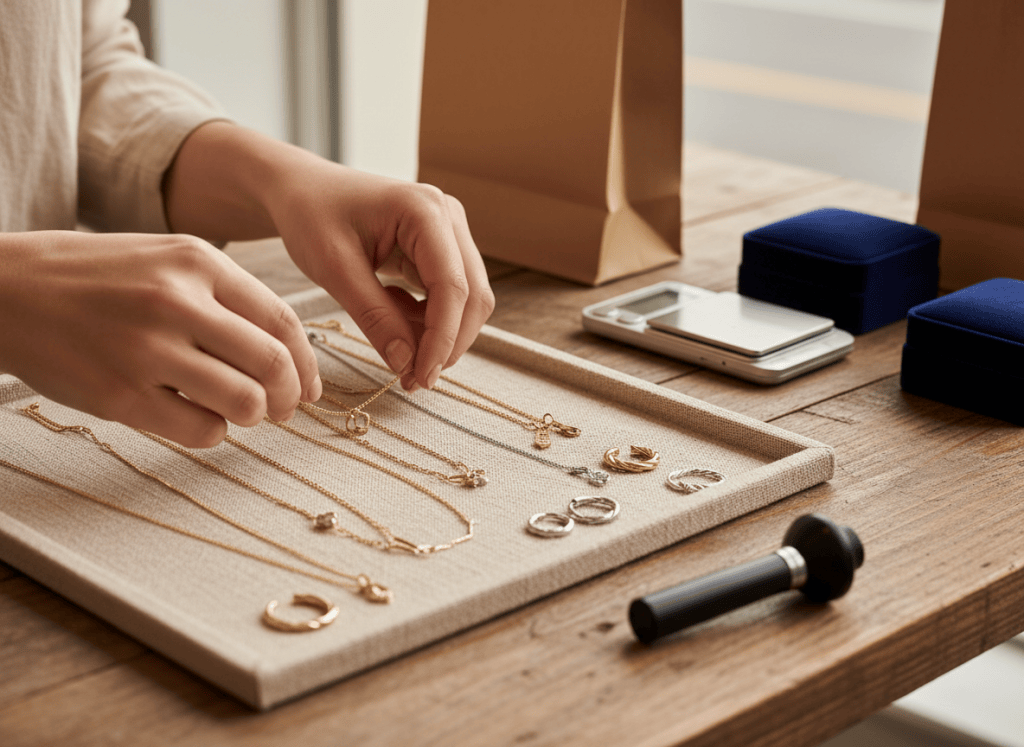
Jewelry is a favorite for boutiques and gift shops. It’s small, light, easy to display, and it sells as an impulse buy and as a gift. But it’s also a category where words like “gold” and “sterling” have specific legal meanings, and quality varies a lot between vendors. This guide covers how to buy jewelry wholesale with confidence.
What types of jewelry can you buy wholesale?
Most shops pick one or two lanes and stick with them, so customers know what to expect. Start by looking at what your shoppers already spend. If most of your gifts sell for $20 to $40, a tray of $150 pieces will probably sit. If your customers ask whether something will turn their skin green, they’re telling you to move up from basic plated metal. Your lane also decides how much paperwork you’ll deal with, how you’ll display pieces, and how much theft risk you’re taking on. It’s easier to add a second lane later than to clear out the wrong one.
- Fashion jewelry. Base metals like brass, copper, zinc alloy, or stainless steel, often plated. Low cost, trend-driven, fast-moving.
- “Demi-fine” jewelry. Sterling silver, gold vermeil, or gold-filled pieces. Mid-range prices, longer-lasting, popular for everyday wear.
- Fine jewelry. Solid gold, platinum, and precious stones. Higher cost per piece and more paperwork.
- Handmade and artisan pieces. Beadwork, wire-wrapped, or metalsmith work from small makers. Unique and often great margins.
What do jewelry material terms actually mean?
The FTC’s Guides for the Jewelry, Precious Metals, and Pewter Industries set out how these terms should be used in the U.S. Here’s what the main ones mean, in plain English.
| Term | What it means | Durability |
|---|---|---|
| Solid gold (10K, 14K, 18K) | Gold alloy all the way through. 10K is 10/24 gold (about 42%), 14K is about 58%, 18K is 75% | Excellent |
| Gold-filled | A layer of gold alloy (at least 10K) mechanically bonded to a base metal, making up at least 1/20 of the item’s total metal weight | Very good |
| Gold vermeil | Sterling silver coated with gold (at least 10K) at least 2.5 microns thick | Good |
| Heavy gold electroplate | Gold (at least 10K) plated at least 2.5 microns thick over another metal | Good |
| Gold electroplate / gold plated | Gold (at least 10K) plated at least 0.175 microns thick over another metal | Fair; can wear off |
| Sterling silver | At least 92.5% pure silver (often stamped 925) | Very good; tarnishes |
| Gold-tone | Gold color only, no required gold content | Varies |
Why it matters for you: if a vendor calls something “gold vermeil” but it’s plated brass, and you sell it with that label, you’re the one passing along a misleading claim to your customers. Ask vendors to confirm materials in writing.
92.5%
Minimum pure silver content for sterling
2.5 microns
Minimum gold thickness for vermeil under FTC guides
100 ppm
Federal lead content limit for accessible parts of children’s products
What rules apply to children’s jewelry?
Jewelry designed or intended mainly for kids 12 and under is a children’s product, and the CPSC treats it that way. According to the CPSC, children’s products with more than 100 ppm total lead in an accessible component are banned. Children’s products also generally need third-party testing and a Children’s Product Certificate. There’s a specific safety standard for children’s metal jewelry, ASTM F2923, and several states also limit cadmium in children’s jewelry.
If you plan to sell kids’ jewelry, only buy from vendors who can provide current test reports and a certificate for each item. If they can’t, don’t stock it. This is general information, not legal advice, so check the CPSC’s business guidance for details.
How do you buy jewelry wholesale step by step?
At a glance: buying jewelry wholesale
1
Choose your lane. Fashion, demi-fine, fine, or artisan, and a retail price range.
2
Find vendors. Jewelry and gift trade shows, online B2B marketplaces, and makers direct.
3
Order samples. Wear-test them for a week or two.
4
Start small. A curated opening order, then reorder the winners.
Why samples matter so much for jewelry
Photos can’t show you how fast plating fades, whether a clasp holds, or if earring posts irritate skin. Wear sample pieces through normal days: showers, hand washing, lotion. Check them again after a week. Our guide on how to order product samples explains how to ask without looking like a freebie hunter.
What should you check before ordering from a jewelry vendor?
Checklist: jewelry vendor questions
- ✅ What is the base metal, and what is the plating (metal, karat, thickness)?
- ✅ Are pieces nickel-free or hypoallergenic, and how do you define that?
- ✅ Are stones natural, lab-grown, or simulated? (It should be disclosed.)
- ✅ Are sterling and karat pieces stamped with a quality mark?
- ✅ For kids’ items: current lab test reports and a Children’s Product Certificate
- ✅ How is each piece packaged, and do you include cards or pouches?
- ✅ What’s your policy on broken or tarnished pieces on arrival?
- ✅ Do you sell to other shops near me, or offer a territory?
One more thing on stamping: a quality mark like “925” or “14K” should be backed by the maker’s or seller’s trademark under federal stamping rules. A vendor who can’t explain their marks is a red flag.
How much should you mark up wholesale jewelry?
Jewelry often carries higher markups than many other gift categories. It takes up little space but needs displays, it gets tried on and handled, small pieces go missing, and styles change. Many boutiques price fashion and demi-fine jewelry at two to three times wholesale. Solid gold and fine jewelry usually carry lower percentage markups because the metal itself is expensive.
Worked example (round numbers): A gold vermeil necklace costs $18 wholesale plus $1 for shipping and a gift box = $19 landed cost.
At 2× ($38): margin = ($38 − $19) ÷ $38 = 50%.
At 2.5× ($48 rounded): margin = ($48 − $19) ÷ $48 = about 60%.
At 3× ($58 rounded): margin = ($58 − $19) ÷ $58 = about 67%.
Check the vendor’s suggested retail price and any pricing policy before you pick a number. For more on the math, see our guides to keystone pricing and what a good profit margin for retail products is.
How do you display and sell wholesale jewelry?
- Group by price. Shoppers relax when they know a whole tray is $30 and under.
- Put small pieces near the register. Studs and simple chains are classic add-on buys.
- Label materials clearly. “Sterling silver” or “14K gold-filled” helps sell the piece, as long as it’s accurate.
- Use a mirror. People buy what they’ve tried on.
- Secure higher-priced pieces. Locked cases or displays within staff view reduce loss.
FAQ
Do I need a license to buy jewelry wholesale?
Most vendors want a registered business and a resale certificate. Some states and cities have extra rules for dealing in precious metals, especially buying from the public, so check locally.
Is gold vermeil better than gold-plated jewelry?
Generally, yes. Under FTC guides, vermeil has a sterling silver base and a thicker gold layer than standard gold electroplate, so it usually lasts longer.
What’s a good opening order for wholesale jewelry?
Start with a tight edit: a handful of styles in your best-selling price range, with enough units to fill a display. Reorder what sells in the first month.
Can I sell children’s jewelry from any wholesale vendor?
Only from vendors who provide the testing and certification required for children’s products. Without them, skip it.
Bottom line
Pick a jewelry lane that fits your shop, learn what material terms really mean, and buy only from vendors who put metals and plating in writing. Wear-test samples, price with room for loss and markdowns, and skip children’s jewelry unless the vendor has the test reports and certificates to back it up.


 Wholesale Handbook
Leave a comment